
How Does the Internet Work?
The internet is the backbone of modern global communication and works by transmitting information across a vast, interconnected network of computers. It is the physical infrastructure that makes the Web and other global information systems possible. Of course, if you’re reading this right now, you probably have a pretty good idea of what the internet is and how to use it. Trying to explain it to someone, on the other hand, can be a bit of a challenge.
We’re here to help you put some of these complicated concepts into words and hopefully show you a few things you might not have known about the internet
The internet is a network of networks
On its most basic level, the internet is a way of connecting computers all around the world. Most of us do this on a much smaller scale in our own home networks. At the heart of your home network is your router, which is the central point through which all your other devices connect. Most home networks are wireless these days, but you could also connect devices to a router using network cables.
While you could just connect two computers together directly, a router acts as a central hub. A router is just a specialized computer whose job is to manage the communication between the computers it’s connected to.
This means that by making one connection to the router, it’s like you made a connection to every other computer the router is connected to. These networks are usually referred to as local area networks (LANs), and they’re the kind of networks that people would set up to have LAN parties to play computer games together before online games were the norm.
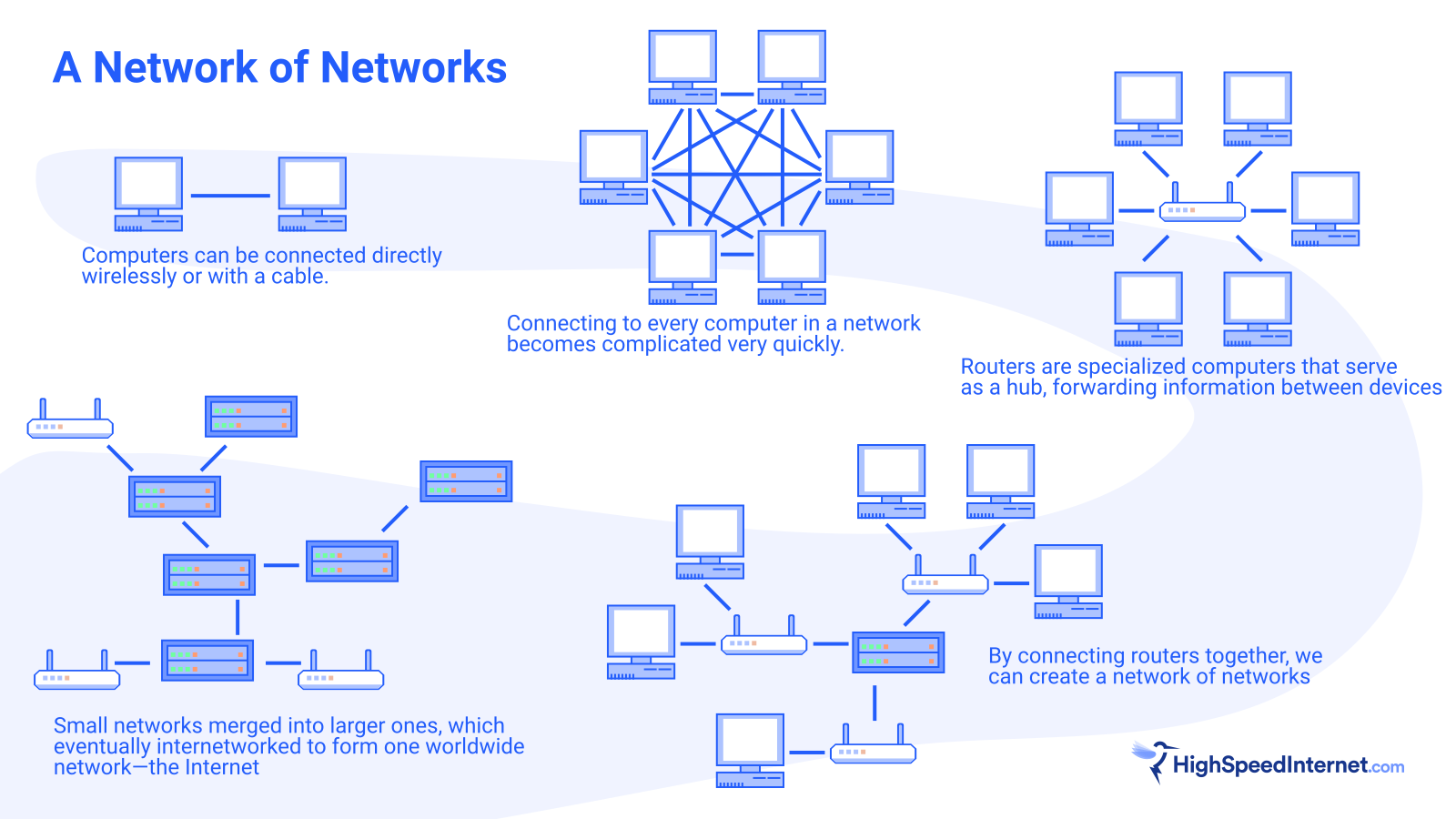
If you wanted to connect your local network to someone else’s, you could connect your routers together directly. You could also get a bunch of people to connect their local networks to the same router, making a network of networks. This is essentially how the earliest computer networks grew together from several large regional networks into one vast internetworked system that we now call the internet. Today, your home network is part of your ISP’s network, which is part of the worldwide network that we call the internet.
Information superhighways
The internet of today now covers the entire planet. But, like your home network or a ’90s LAN party, it’s made up of a bunch of physical devices linked together. The bulk of the internet’s infrastructure is made of fiber-optic cables because fiber is awesome. Underground fiber cables cover the continent and undersea cables cross entire oceans, allowing near-instantaneous communication around the world.
But where does all this infrastructure come from? Fiber infrastructure doesn’t grow on trees, so someone has to be building all this stuff.
How the internet is built
Though we don’t often have to think about it, telecom companies spend massive amounts of money to build and maintain the routers and cables necessary for the internet. Operating these networks is a huge industry in itself. Our relatively smooth experience of using the internet belies the complicated business deals under the surface that keep the whole thing running.
Imagine you want to send an email to your friend in London. You pay your local internet service provider (ISP) to connect to its network, but while it owns the underground cables that connect to your house, it doesn’t own cables that reach all the way to Europe.
In order to connect its customers to the rest of the world, your local ISP will have to make a deal with a larger network and pay for transit.1 The larger network might have to pay for transit on an even bigger network, or it might have a peering agreement with other networks, basically agreeing that “You’re free to use my network if I’m free to use yours.”
Thanks to these business deals between telecom companies, your ISP is allowed to pass your data along to larger and larger networks until it reaches an internet backbone that can send it to the East Coast, across the Atlantic, and finally to your friend’s computer in London.
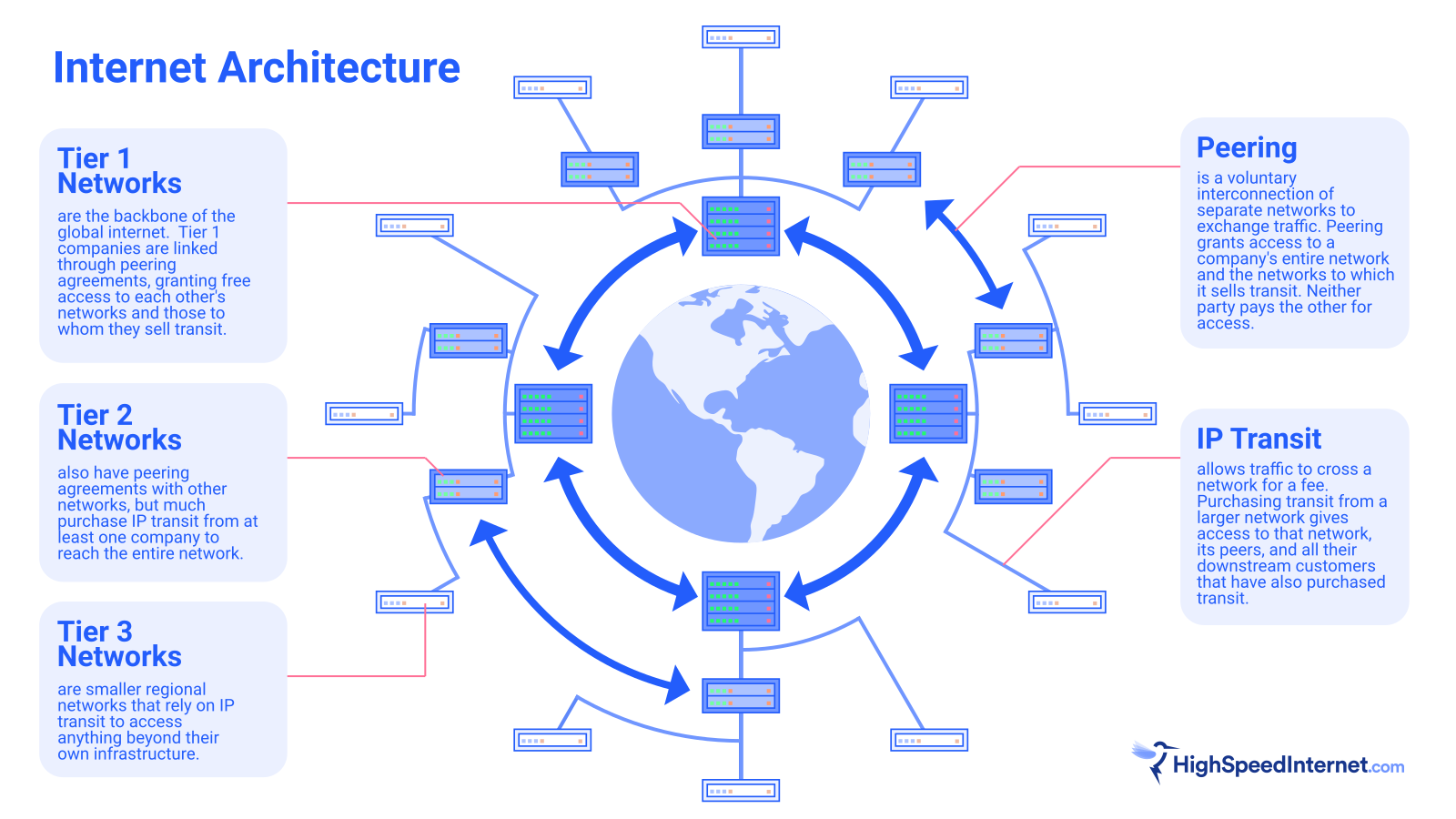
These different kinds of networks are often grouped into tiers. The biggest networks that form the backbone of the internet are referred to as Tier 1 networks. Tier 1 networks are owned by large telecom companies—like AT&T and CenturyLink in the US and Deutsche Telekom in Germany—and are connected to one another through peering agreements. Tier 2 and Tier 3 networks, in contrast, must purchase transit from larger networks in order to reach the rest of the internet.2
Sending and receiving data on the internet
Now that we have a massive globe-spanning network, how do we actually find anything on the internet? The rules for sending and receiving information across all of these interconnected networks is known as the Internet Protocol (IP).
For this system to work, every device connected to the internet is given an IP address. When a piece of information like a file or an image is sent across the internet, it’s first chopped up into tiny packets of information, each of which is tagged with a header containing the IP address of its starting point and its destination, just like a letter being mailed.
Navigating a decentralized network
Perhaps surprisingly, these packets aren’t sent in a straight line to their destination. Since the internet was developed during the Cold War, the US didn’t want a communication system that could be taken out by a precise nuclear strike. Instead, packets are sent out in all directions, so even if a big chunk of the network went down, the information would just find a way around the hole.
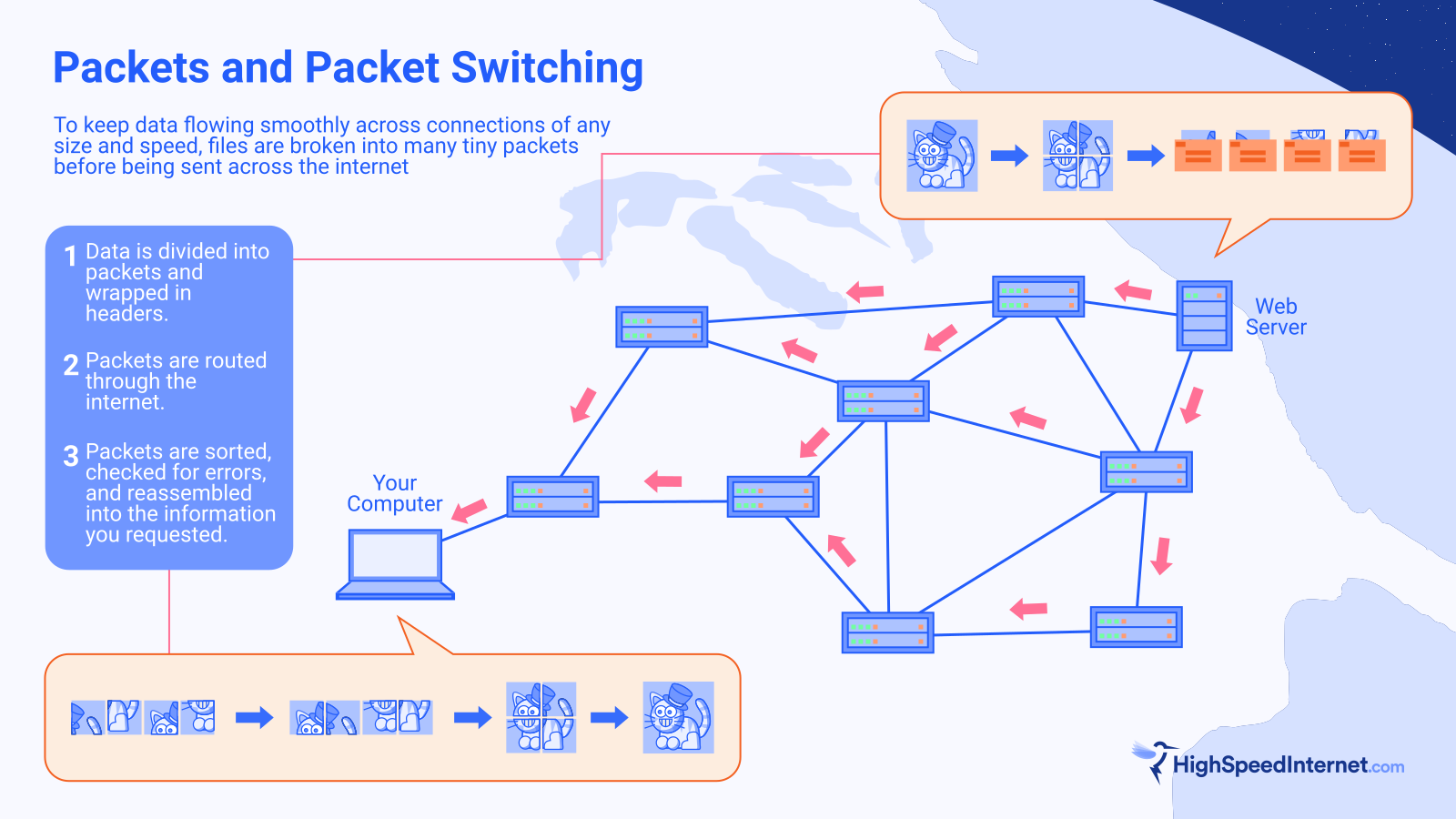
This also means that since packets take different paths, they can arrive at their destination in the wrong order. To deal with this, packets also contain additional metadata to put the information back in the correct order and make sure none of it was lost or damaged.


0 Comments